Which Is More Suitable For Your Space, Stretch Ceiling Or Gypsum Ceiling?
By SmartGlow
April 10th, 2026
Not sure if to choose stretch ceiling or gypsum board? This article comprehensively compares durability, moisture resistance, aesthetic design, installation speed, and long-term cost, analyzes stretch ceiling systems and diversified stretch ceiling designs, and compares stretch ceiling cost with gypsum board cost-effectiveness. It provides a practical guide for purchasing suspended ceilings for Canadian homes, offices, kitchens, bathrooms, and basement spaces.
When planning decoration or new construction projects, ceiling design is one of the core designs that affect the spatial effect. Although gypsum ceilings are still the traditional choice for most residential and office spaces, stretch ceiling systems are rapidly becoming a high-quality alternative for home and commercial spaces.
Both options have their own advantages and disadvantages, and the final choice depends on your budget, style goals, and the long-term usage needs of the space. This article will provide a clear comparison between stretch ceilings and gypsum ceilings, covering durability, aesthetics, and more stretch ceiling cost、 Core dimensions such as installation process and post maintenance, while answering the most common questions asked by homeowners and business owners before selection.
Whether you are selecting PVC stretch ceilings for modern offices, exploring fabric stretch ceiling solutions for home furnishings, or wanting to understand the differences between traditional gypsum ceilings and stretch ceiling systems, this comparison can help you make wiser decisions.
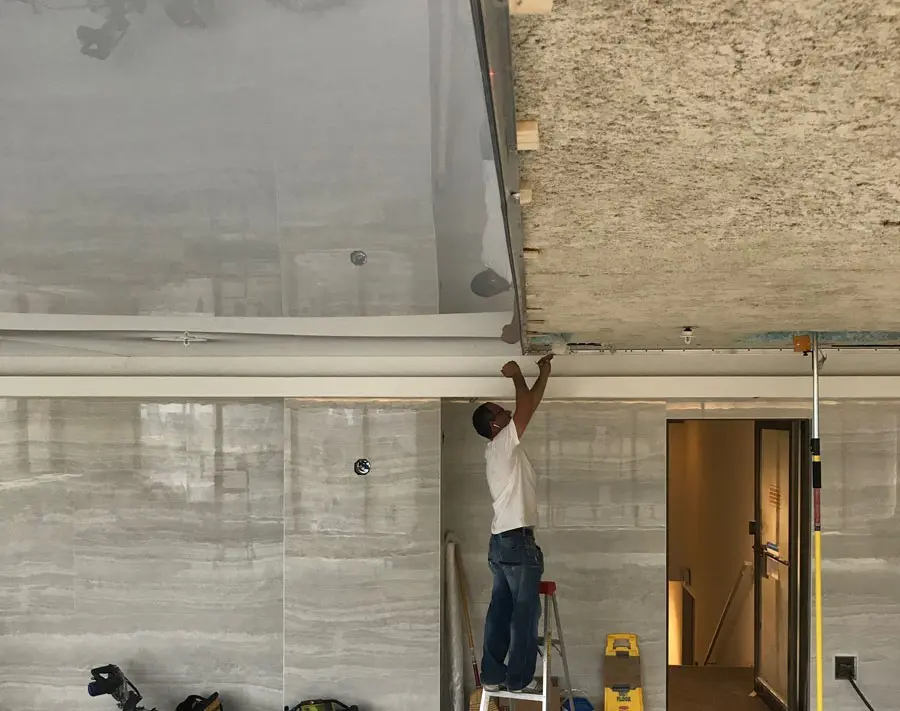
What is a stretched ceiling?
Stretch ceiling is a suspended ceiling system made of lightweight fabric or PVC stretch ceiling film. The material will be precisely cut to size, heated and fixed by stretch ceiling profiles installed on the wall. After cooling, it can form a smooth and seamless flawless surface. They have become highly regarded high-end ceiling solutions due to their smooth appearance, rich stretch ceiling design options, and excellent durability. Click here to learn more about the functions and designs of stretching ceilings.
What is gypsum board ceiling?
Gypsum board (also known as drywall or gypsum wall panel) is the most mainstream ceiling and wall foundation building material in the North American home decoration and tooling industry. It is made of gypsum as the core material and covered with thick paper layers, which is the standard choice for traditional ceiling construction.
During installation, the gypsum board panel needs to be fixed to the wooden or metal keel frame with screws or nails, and then subjected to multiple processes such as joint sealing tape treatment, scraping of joint paste, fine polishing, and multiple coats of paint to finally create a flat and uniform top surface effect. As a traditional ceiling solution, it is a common base for stretch ceiling system renovation and a core reference for comparing stretch ceiling costs, widely suitable for various home decoration and tooling scenarios.
Stretching Ceiling vs Gypsum Board: Comparison Table of Core FeaturesDurability: Which one is more durable?Durability of Stretching CeilingStretch ceiling itself has excellent durability, with a sturdy and elastic material that can withstand slight impacts without cracking easily. It has excellent moisture resistance and is very suitable for use in spaces such as bathrooms, kitchens, basements, etc. that are sensitive to humidity. Under normal use and maintenance, stretch receivers can be used stably for 20-30 years with almost no need for large-scale renovation.One of its unique advantages is the ability to temporarily support accumulated water in the event of accidental water leakage, preventing water stains from directly dripping and damaging furniture and floors. The waterproof material can withstand a certain amount of accumulated water weight, and after the drainage is completed, the top surface can be restored to its original state, which is much more practical than traditional ceiling materials.Durability of gypsum boardGypsum board structure has limited strength and is prone to various common problems during long-term use:
- Slight settlement or vibration of the house may cause cracking of the board surface
- Prone to dents, damages, and even punctures upon impact
- After encountering water, it will quickly soften and turn yellow, and long-term dampness can also easily breed mold
- The repair marks are obvious, and only experienced construction parties can achieve relatively no marks
- The service life of ordinary gypsum board ceilings is about 10-15 years, after which problems such as cracking, yellowing, and peeling will gradually occur, requiring frequent repairs or overall repainting.
Conclusion: Overall, stretch ceiling system is a more durable choice, especially in humid environments where its advantages are more prominent.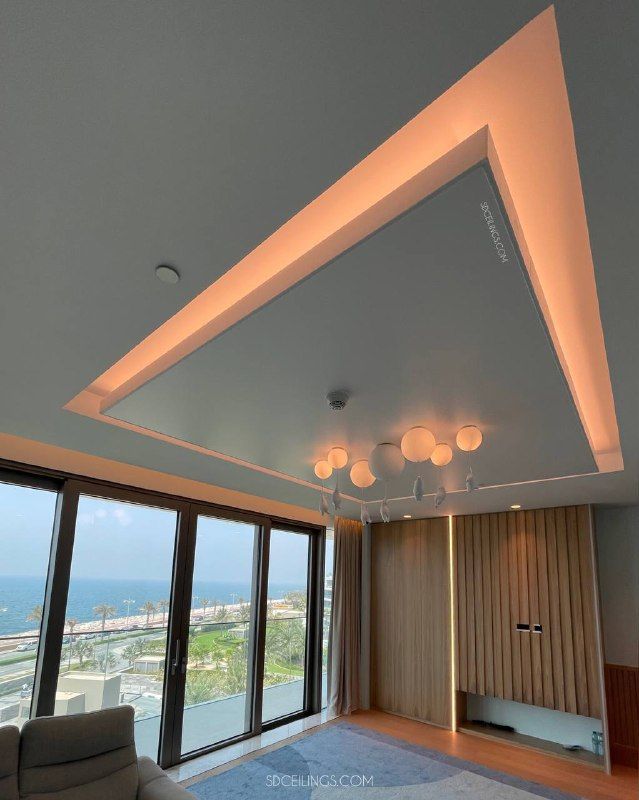 Beauty: Which one looks better?Stretch ceiling design optionsStretch ceiling has a high degree of freedom in exterior design and is suitable for a wide range of styles. Common effects include:
- High gloss mirror stretched ceiling can visually expand space and enhance brightness
- Matte stretch ceiling, presenting a classic smooth non reflective top effect
- Satin stretch ceiling with a soft and delicate luster
- Support customized printing, patterns, photos, and personalized stretch ceiling design
- Can simulate various texture effects such as stone, fabric, metal, etc
At the same time, it can easily achieve irregular shapes such as arcs, waves, and multiple layers, and integrated lighting such as embedded tube lights, pendant lights, magnetic track lights, and backlit LED panels can be directly integrated into it, fully enhancing the overall modernity and delicacy.Gypsum board design optionsGypsum board tends towards a simple and traditional decorative style, with common design forms including:
- Can be painted in any color, suitable for basic decoration styles
- Can do texture treatments such as pulling hair, orange peel, popcorn, etc. (nowadays many families choose to remove such top surfaces to optimize spatial effects)
- Can be used for hierarchical and descending styling, used to block pipelines and routes
Although gypsum board also has some plasticity, its design boundaries are relatively clear, and it is far less flexible than stretch ceiling systems in complex shapes and creative expressions.Conclusion: Stretching ceiling has significant advantages in design freedom and modern texture, while gypsum board is more suitable for traditional decoration styles that prefer simplicity and classic style.Cost: Which one is more affordable?Cost of Stretching CeilingThe price of stretch ceiling base finishes typically ranges from $8 to $15 per square foot, depending on the PVC stretch ceiling film material, surface treatment process, and design complexity. If customized patterns, layered designs, or professional lighting systems are chosen, the stretch ceiling cost will correspondingly increase.This type of ceiling has extremely low maintenance costs in the later stage, requiring almost no repair or repainting. Although the initial investment is higher, long-term use can effectively save comprehensive expenses.Gypsum board costThe installation cost of gypsum board is significantly lower, typically ranging from $1.50 to $3.00 per square foot, making it budget friendly in the initial stage. However, long-term use will incur significant additional costs:
- Regular painting (usually every 5-10 years)
- Daily repair of cracks, dents, etc
- Repair and treatment of water damage and mold
- After years of use, the total maintenance cost of gypsum board will continue to accumulate.
Conclusion: Gypsum board has more advantages in initial investment, while stretch ceiling system has higher overall cost-effectiveness from the perspective of long-term use and maintenance.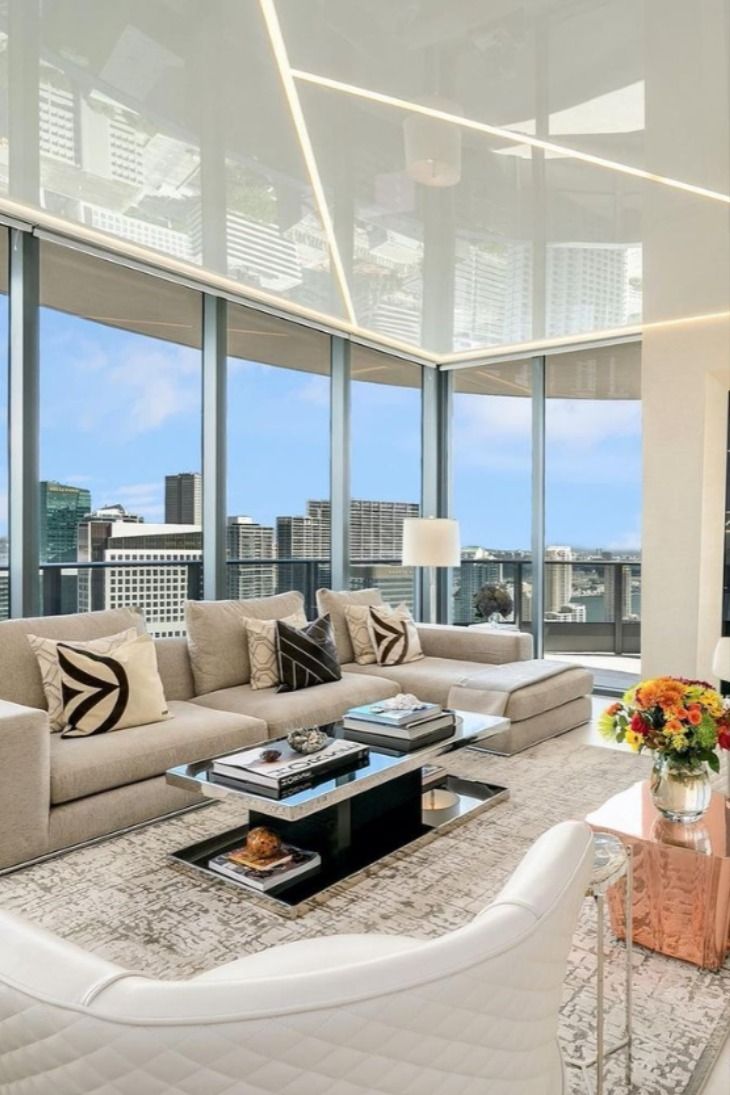 Installation time: Which one is faster?Stretching ceiling installationThe installation process of stretch ceiling is efficient and simple, with an average completion time of only 1-2 days per room. The construction process is almost dust-free and free of dirt and mess, without the need for polishing and painting processes, and can be directly installed on top of the original gypsum board or plaster surface without dismantling the old structure. After installation, the space can be put into use immediately without waiting for drying.Gypsum board installationThe construction period of gypsum board is significantly longer, usually requiring 3-5 days or even longer depending on the room size and drying conditions. The entire process involves multiple steps: fixing the board, processing the joints, scraping putty, polishing, applying primer and topcoat. Each step requires waiting for the material to dry, which seriously affects the construction progress. Simultaneously polishing will generate a large amount of dust, which requires specialized cleaning in the later stage.Conclusion: Both in terms of installation speed and construction cleanliness, stretch ceiling systems are significantly better than traditional gypsum boards.Security: Which one is safer?Stretching ceiling safetyStretch ceiling is made of non-toxic and flame-retardant materials, with a dense and smooth surface that will not peel off or emit dust. It is more friendly to people with respiratory sensitivity such as allergies and asthma, and has higher long-term safety.Gypsum board safetyGypsum board itself is a safe building material, but during installation, polishing, and later repair processes, a large amount of gypsum dust is generated, which can easily irritate the respiratory tract. In addition, gypsum board is prone to mold growth when exposed to water and moisture, posing a hidden danger to indoor air quality and human health.Conclusion: In terms of long-term use and health risks, stretch ceiling systems have better safety, especially in humid spaces.Sound insulation: Which type of sound insulation effect is better?Stretching ceiling sound insulation performanceStretch ceiling itself has a certain sound absorption effect and belongs to a moderate level of sound insulation performance. If high requirements are placed on noise control, acoustic panels can be installed above the membrane or paired with stretch fabric soundproof walls to further enhance the overall sound insulation and noise reduction capabilities. (Click here to learn more about stretch fabric soundproof walls)
Gypsum board sound insulation performanceGypsum board, when combined with soundproofing cotton, insulation materials, or using a double-layer gypsum board structure, can achieve excellent soundproofing effects and is a commonly used soundproofing solution in traditional decoration.Conclusion: Under conventional configuration, gypsum board has better sound insulation performance; Only when the stretch ceiling system is upgraded with additional acoustic components can it compete with it in terms of sound insulation.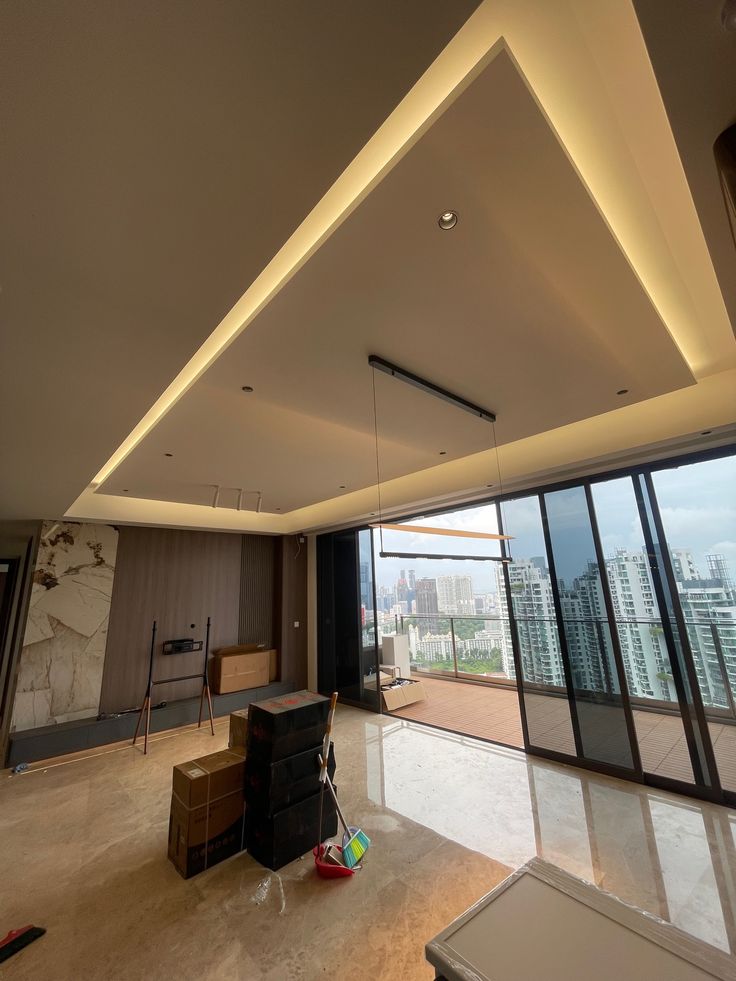 Summary of advantages and disadvantages
| Comparing dimensions |
Stretch Ceiling |
Gypsum board (drywall) |
| installation methods |
Installed below the original ceiling and fixed by stretch ceiling profile, without damaging the original top surface, the construction is fast and dust-free |
Directly fixed on wooden/metal keel, requiring multiple processes such as jointing, scraping, polishing, and painting, with a long construction period and high dust content |
| appearance and design |
The surface is smooth and seamless, supporting various textures such as matte, satin, and glossy. It can be customized with stretch ceiling design and full-color printing, suitable for 2D/3D styling |
It can create a smooth painted surface and support texture modeling, but it is prone to seam marks and difficult to construct complex shapes |
| durability |
Moisture proof, mold proof, crack proof, strong deformation resistance, long service life |
Easy to be damaged by water, damp and moldy, susceptible to cracking and bulging due to temperature and humidity, durable |
| maintenance and refurbishment |
It can be disassembled and reinstalled at any time, making it easy to inspect the top pipeline, and the maintenance cost in the later stage is extremely low |
Relying on construction techniques requires regular painting, repairing cracks/holes, and refurbishment requires re polishing and painting, resulting in high maintenance costs |
| function integration |
It can perfectly integrate embedded lighting, ventilation openings, sound systems, etc., creating an integrated intelligent top surface |
Reserved openings are required, as integrated equipment can easily damage the integrity of the top surface, resulting in a lower aesthetic appeal compared to stretched ceilings |
| Cost and Acquisition |
High initial investment, requiring a professional team to install and adapt to high-end decoration needs |
Affordable prices and widely available materials are the mainstream choices for traditional decoration |
| Applicable scenarios |
Luxury residences, commercial spaces, humid areas (bathrooms, kitchens), and irregular roof renovations |
Basic decoration for ordinary residential, office and other conventional spaces with limited budget |
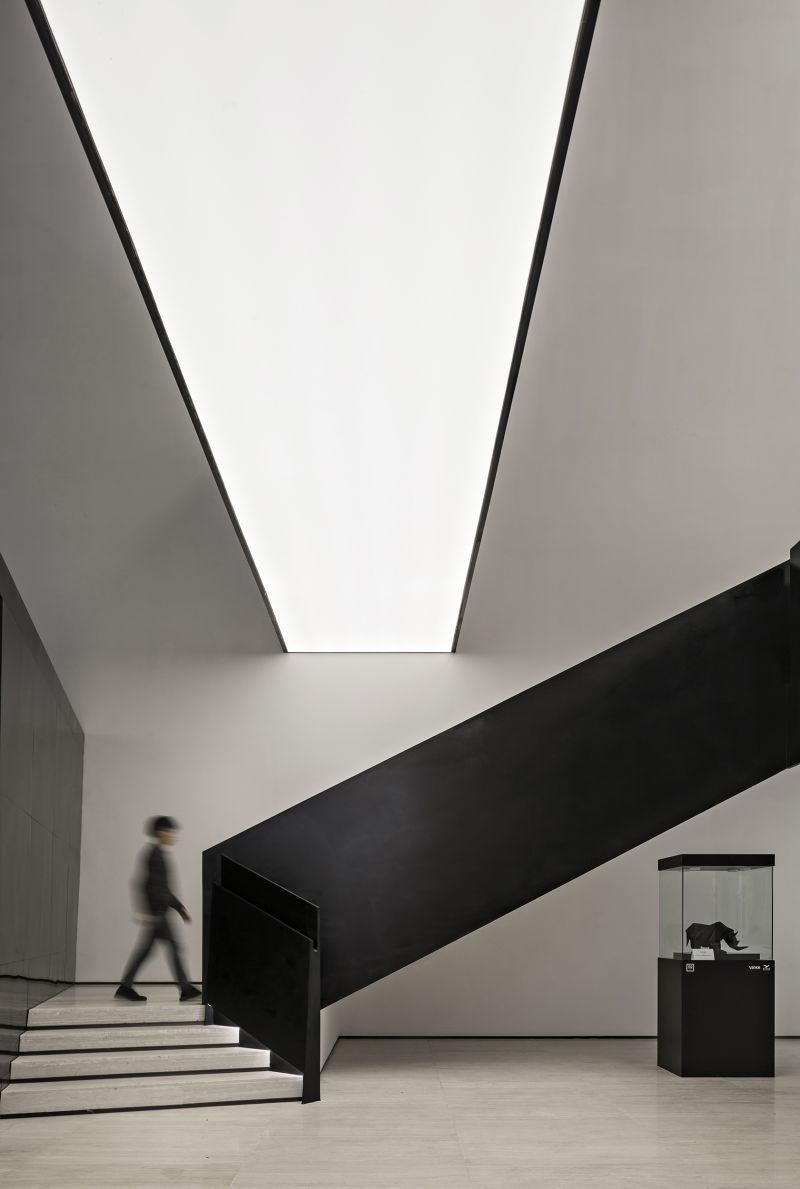 Optimal solutions for suspended ceilings in different spacesliving roomPursuing modern texture and overall lighting atmosphere, stretch ceiling is the ideal choice; Prefer a stable and classic spatial style, while gypsum board ceilings never go out of style.kitchenCompared to gypsum board, stretch ceiling has stronger moisture and stain resistance, and can handle kitchen fumes and humid environments with ease. It is also easier to maintain in the later stage.bathroomWith excellent waterproof and anti mold properties, stretch ceiling is undoubtedly the optimal solution for bathroom ceilings, which can maintain the top surface intact for a long time and prevent mold and deformation problems.basementStretch ceiling can easily hide various pipeline routes and facilitate later maintenance; If gypsum board needs to cover pipelines, additional ceiling partitions and shapes need to be made.officeBoth materials can meet the basic usage needs, while stretch ceiling can further enhance the sense of spatial design, while supporting acoustic optimization, making it more professional and high-quality.Final conclusion: Stretching ceiling vs gypsum boardIf budget is your primary consideration, gypsum board is still the mainstream choice. It is affordable, easy to obtain materials, and presents visual effects that are in line with the public's perception of traditional tops.If you value durability, moisture resistance, and design freedom more, stretch ceiling is undoubtedly a better solution. Although the initial investment is relatively higher, its long service life, extremely low post maintenance costs, and efficient and clean installation methods make it a highly cost-effective investment in the long run.If you need to learn more details, please feel free to contact us and schedule a one-on-one consultation with a professional consultant.
Previous
Must-read For Beginners! The Entire Process Of Installing A Stretched Ceiling
Read More
Next
How to Install Stretch Fabric Soundproofing Wall on Existing Walls
Read More


